
By Hanane Ennabli / Ihssane Haddi
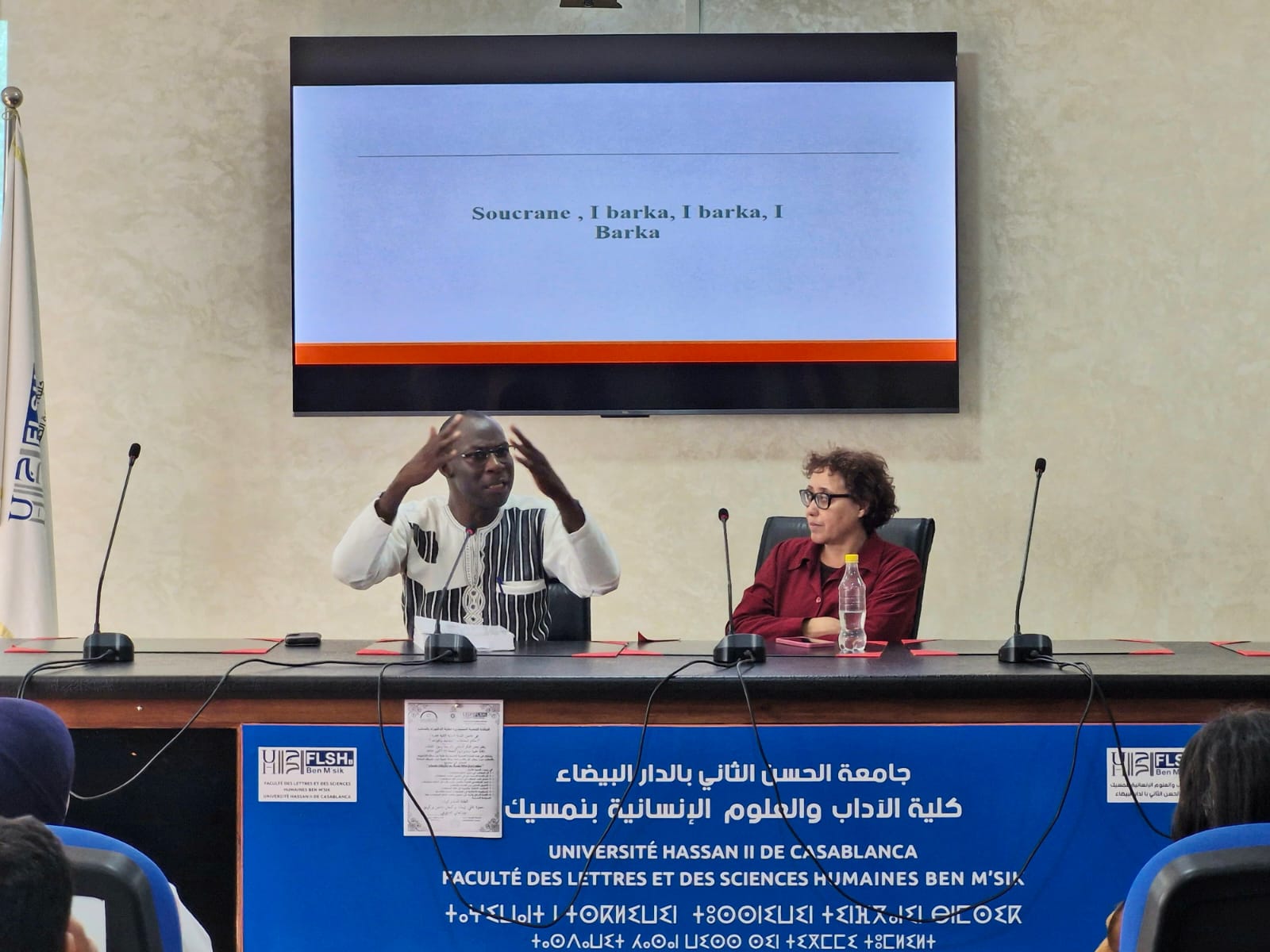
Burkinabè researcher and academic Patrice Kouraogo highlighted the traditional educational and cultural knowledge and know-how of the Moose people in Burkina Faso, emphasizing their role in educating individuals, organizing social relations, and preserving cultural identity. This address took place during a scientific conference held on Tuesday, October 27, 2026, in the Abdelouahed Khairi Conference Hall at the Faculty of Letters and Human Sciences of Ben M’Sik, part of Hassan II University in Casablanca.
The session was moderated by Professor Samira Douider. The conference was organized by the Laboratory of Narratology and Cultural Discourses, in partnership with the French Language and Literature Section of the faculty. In his presentation, titled “Educational and Cultural Know-How Among the Moose,” Kouraogo—Director of Research at the Institute of Social Sciences under Burkina Faso’s National Center for Scientific and Technological Research—presented a body of knowledge, practices, and values passed down from generation to generation that contribute to the organization of social life and the construction of the community’s cultural identity.
The Moose people are among the main ethnic groups in Burkina Faso. They belong to the Gur group and are mainly located in the Volta Basin. Its members speak Mooré, a language that constitutes one of the primary components of their cultural identity. Beyond its function as a means of communication, this language is also tied to collective belonging and ways of life, highlighting the importance of studying the language and oral heritage to understand the knowledge and values transmitted across generations.
The researcher explained that this knowledge covers several domains, notably the mastery of the local language (Mooré), the understanding of norms and values recognized within the community, the acquisition of skills related to protection and defense, and the learning of social functions and responsibilities. These areas demonstrate an educational system that is not limited to acquiring practical skills, but also contributes to internalizing the rules of conduct that structure relationships between individuals and define their responsibilities within the group.
Regarding communication skills, Kouraogo stressed the importance of mastering speech and using language properly in social relations, given the influence of words on an individual’s dignity, reputation, and standing within the community. Words can serve to protect the dignity of others or, conversely, undermine it. The choice of words and the manner of expression thus represent skills linked to education, character building, and the organization of human relationships.
The researcher also indicated that local knowledge encompasses learning ways to safeguard life and prevent dangers, as well as preparing individuals to assume their social responsibilities and understand the roles associated with their position in the community. These practices rely on the transmission of rules and customs that facilitate social integration, respect for obligations, and the adaptation of behaviors to various situations.
Furthermore, Kouraogo addressed methods of child-rearing and behavioral correction, particularly the use of sanctions for educational purposes. These practices form part of the mechanisms used to reinforce social rules and discipline, alongside forms of oversight and monitoring that contribute to respecting obligations and organizing collective activities.
Regarding social relationships, the researcher discussed skills related to cooperation, solidarity, and respect for others, as well as their role in building balanced relationships and strengthening group cohesion. The knowledge presented also includes matrimonial traditions—from the choice of a spouse to the social procedures involved in concluding and accepting the union—and the resulting relationships between spouses, their families, and their broader social environment.
The conference also covered knowledge and practices associated with death, including rites for preparing the deceased, organizing funerals, and supporting grieving families. These practices reveal the social and cultural dimensions surrounding death, as well as the role of inherited traditions in organizing the relationship between the individual and the community at various stages of life.
Kouraogo emphasized that this knowledge and know-how are closely tied to the daily life of the community and are not confined to formal education. They are transmitted within the family through social interactions and inherited practices. This transmission contributes to shaping individuals, grounding values and norms, preserving collective memory, and passing down accumulated experiences from one generation to the next.
Addressing the challenges facing this system, the researcher noted the effects of modernity and accompanying social transformations, particularly changes in lifestyles, values, and practices. These developments raise the question of the continuity of local knowledge and the community’s ability to pass it on to younger generations amid ongoing social and cultural shifts.
Finally, Kouraogo stressed the importance of viewing this knowledge and know-how as an educational and cultural heritage that reflects the community’s accumulated experience. Preserving, documenting, and promoting them represent key priorities due to their role in passing values across generations, safeguarding collective identity, and strengthening social cohesion. Studying them also helps broaden research on African knowledge systems and intangible cultural heritage.
The conference concluded with a Q&A session with attending students, who asked questions and sought clarifications on the presentation’s content and its educational and cultural dimensions. This discussion enabled an exchange of perspectives on the local knowledge of the Moose people and ways to preserve it in the face of contemporary social and cultural changes.
The research of Professor Patrice Kouraogo, Director of Research at the Institute of Social Sciences under the National Center for Scientific and Technological Research of Burkina Faso, focuses on the social and cultural dimensions of African heritage, with a special emphasis on the oral heritage of the Moose people. His work includes analyzing folktales, proverbs, and symbols present within this community, as well as the educational and social meanings they convey and the cultural values and representations they reflect. Within this framework, he conducted a study dedicated to the sayings and representations associated with animals in Moose culture, examining their socio-cultural dimensions, their role in transmitting knowledge and values, and their contribution to expressing collective identity.