
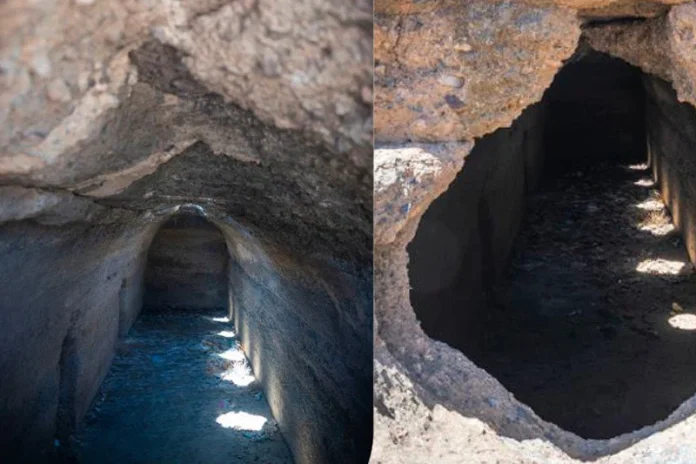

Researchers, public institutions and civil society organizations will gather at Mohammed VI Polytechnic University (UM6P) in Benguerir on June 9 to launch a scientific initiative aimed at preserving and promoting the Almohad Cisterns of Sidi Bouathmane, a 12th-century hydraulic complex in Morocco’s Rhamna province.
The event, known as the D.Days Scientifique des Citernes Almohades de Sidi Bouathmane, is being organized by the Province of Rhamna, Territorial Empowerment & Development (OTED) and a group of academic and institutional partners.
Organizers say the initiative seeks to bridge scientific research and territorial development efforts to better document, preserve and enhance one of Morocco’s historic water management systems.
Located in the village of Igout in Rhamna province, the site dates back to the Almohad period and includes a dam, a network of canals, a settling basin and nine vaulted cisterns. The complex was designed to manage water resources in a semi-arid environment and is considered an important example of medieval hydraulic engineering.
The site was added to Morocco’s list of historic monuments in January 2024.
The June 9 gathering will bring together archaeologists, historians, engineers, geologists, museum specialists, local authorities and civil society representatives to establish a shared scientific framework for studying and safeguarding the site.
Three thematic workshops are planned during the event. The first will focus on the site’s historical and archaeological significance, the second on hydraulic engineering and construction materials, and the third on the relationship between the site, its surrounding environment and local communities.
Participants are expected to identify research priorities, assess existing knowledge gaps and contribute to the development of a reference database on the cisterns.
Among the institutions participating are Cadi Ayyad University, Mohammed VI Polytechnic University, Chouaib Doukkali University, the National Institute of Archaeology and Heritage Sciences (INSAP), the Mohammed VI Museum for Water Civilization in Morocco and representatives from government ministries, municipalities and civil society organizations.
The initiative is also linked to the Rhamna Geopark project, which is seeking UNESCO Global Geopark status. Project leaders view cultural and geological heritage as tools for education, ecotourism and local economic development.
Organizers said the scientific meeting represents an opportunity to strengthen cooperation between researchers and local stakeholders while laying the groundwork for the long-term preservation and promotion of one of Morocco’s most significant medieval hydraulic heritage sites.